
Patented Technology — The Engineering Foundation of Atlas
A fundamentally different approach to flow control, protected by 2 United States patents
The performance of Atlas Severe Service Control Valve is not the result of incremental improvement over existing designs. It is the outcome of a fundamentally different approach to flow control, protected by two United States patents granted to inventor Mark A. Lobo and assigned to Valve Systems International LLC. These patents cover the core mechanical innovation that makes Atlas capable of operating where standard severe service control valves can’t: the rotary-to-linear helical bevel gear actuation system. The result is the unlikely combination of high capacity, precise flow modulation, and wide range of control in high DP applications. Atlas works under the high pressure conditions of the oil and gas industry with low-torque rotary actuation and its unique, cavitation-resistant flow path.
US Patent 9,103,421 B2
The Foundation
Rotary-to-Linear Motion Actuator Having a Helical Bevel Gear and Method of Use Thereof Granted: August 11, 2015 — Inventor: Mark A. Lobo — Assignee: Lobo Engineering PLC
The central challenge in designing a severe service control valve is mechanical: how do you translate the rotary motion of an electric actuator into the precise linear movement needed to modulate flow, while simultaneously withstanding the enormous axial forces generated by high differential pressure — sometimes exceeding 6,000 psi — without damaging the valve’s internal components? Standard Severe Service Control Valve designs resolve this problem imperfectly, relying on actuator architectures that either require excessive torque, compromise positional accuracy, or transmit destructive axial loads directly to actuation components.
US Patent 9,103,421 describes a fundamentally different solution. A stemmed pinion gear engages a helical bevel ring gear arranged along a helical path on the outer circumference of a rotatable sleeve. The teeth of the bevel ring gear are arranged at the same pitch as the external load-bearing threads on the sleeve, which engage internal threads in the valve body. When the pinion rotates, it drives the bevel gear along its helical path, which simultaneously causes the sleeve to rotate about its axis and translate linearly along it — a two-stage mechanical action that converts low-torque rotary input into precise linear seat displacement. Critically, the external threads of the sleeve and the internal threads of the valve body are load-carrying: they resist the full axial load imparted by the pressure drop across the fixed seat orifice, protecting the actuation mechanism from the forces that would otherwise destroy it. The flow passage area is modulated by the axial movement of the seat orifice relative to a fixed contoured plug assembly, enabling smooth, continuous, cavitation-resistant control across the full operating range of the severe service control valve — from near-zero to maximum flow, at full choked-flow differential pressure. This patent establishes the fundamental actuation architecture upon which all Atlas severe service control valves are built.
US Patent 9,404,561 B2
The Refinement
Rotary-to-Linear Motion Actuator Having a Helical Bevel Gear and Method of Use Thereof Granted: August 2, 2016 — Inventor: Mark A. Lobo — Assignee: Valve Systems International LLC
Engineering a severe service control valve capable of sustained operation in oilfield pump testing, high-pressure hydrocarbon processing, or produced water injection requires more than a correct mechanical principle — it requires a production-ready architecture that can be precisely assembled, calibrated in the field, and rebuilt without specialized tooling. US Patent 9,404,561 is a continuation-in-part of US 9,103,421 and covers a refined version of the helical bevel gear actuation system that introduces a critical structural innovation: the thrust tube. In this evolved design, the rotatable sleeve — which carries the helical bevel ring gear and controls seat position — is received within an adjustable thrust tube that engages the valve body. The external threads of the sleeve engage the internal threads of the thrust tube, and the thrust tube is locked axially into position within the valve body using a thrust tube jam nut. This arrangement gives the thrust tube and sleeve assembly a defined, adjustable zero reference point — a capability that is essential for a severe service control valve that will accumulate thousands of operating cycles in continuous pump testing or process control applications, and that must maintain positional accuracy over its entire service life. The load-carrying threads of both the sleeve and the thrust tube resist the axial forces generated by the pressure drop across the seat orifice, distributing those forces structurally rather than transmitting them to the actuation train. The plug assembly, positioned upstream of the seat orifice, is supported by radially projecting vanes on the upstream side of the valve body, keeping the contoured plug centered within the flow path without requiring downstream structural support — a geometry that directly enables the straight-through, axisymmetric annular flow path that prevents cavitation damage in Atlas severe service control valves. Together, these two patents define a complete and exclusive mechanical platform: a severe service control valve actuation system that is precise, durable, field-serviceable, and protected from the axial and erosive forces that limit the performance of every competing design.
What Patent Protection Means for Your Operation
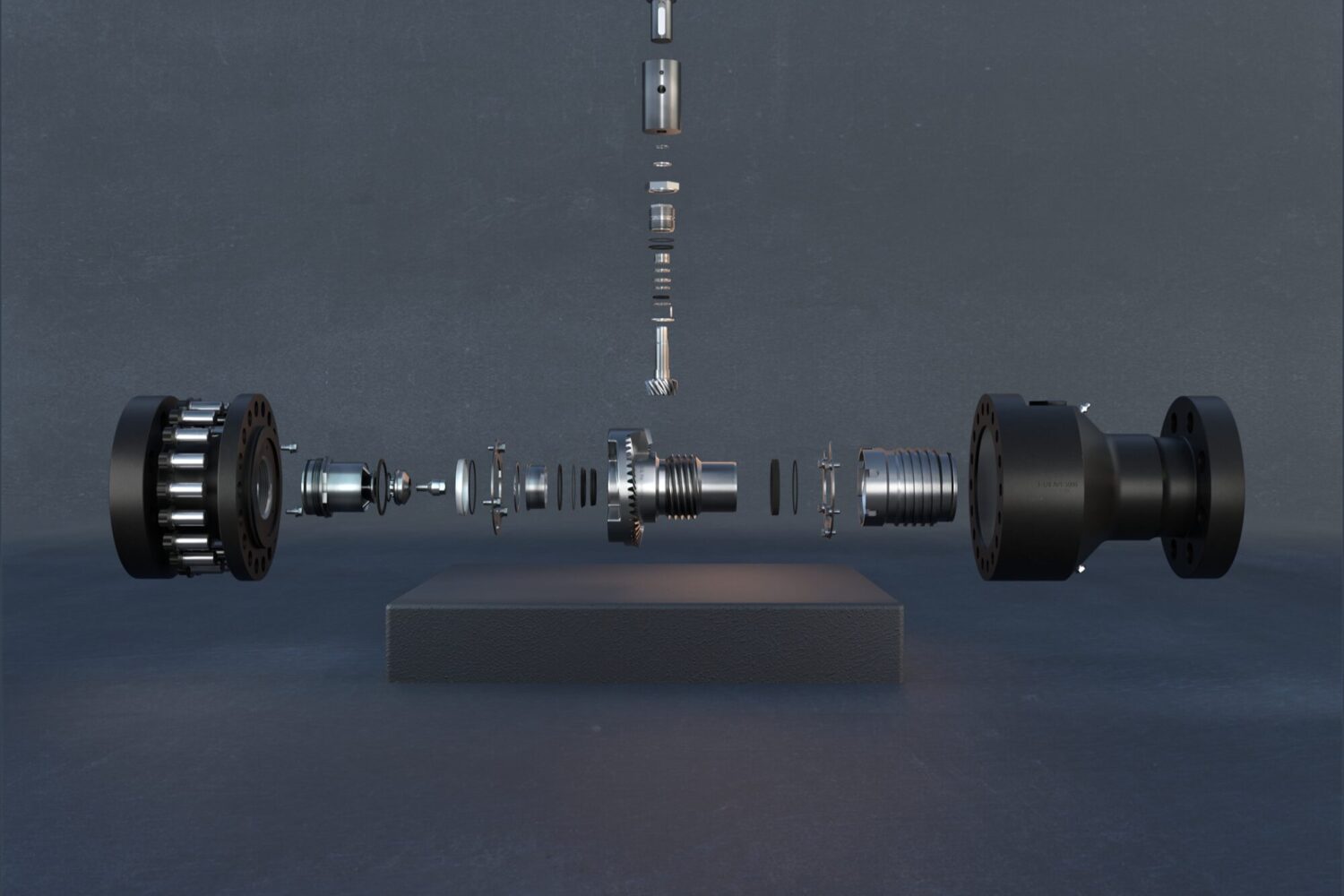
When you specify an Atlas severe service control valve, you are not selecting a product that approximates an established industry standard. You are selecting the only valve in the market built on this patented actuation architecture — an architecture that the U.S. Patent and Trademark Office has examined and confirmed as a genuine, non-obvious invention in the field of fluid flow control. No competitor can replicate the helical bevel gear actuation system, the thrust tube adjustment mechanism, or the specific combination of axial load management and straight-through flow geometry that these patents protect. For engineers and procurement teams evaluating severe service control valve options in choked-flow, high-differential-pressure, or continuous-service applications, this matters: the performance advantages of Atlas are not incidental features that a competing product can match with design iteration. They are the direct consequence of a patented mechanical innovation that remains exclusive to VSI.
Book Your Free Valve Audit
Let our engineering team analyze your severe service application and show you what the Atlas SSCV can do for your operation.