
Severe Service Control Valves Atlas
The high-capacity, high-recovery control valve that eliminates cavitation, operates below 60 dB, and delivers up to 700:1 control range at pressures up to 6,000 PSI.
What Is the Atlas SSCV?
Severe Service Control Valves Atlas are revolutionary high-capacity, high-recovery control valves designed to withstand continuous choked-flow conditions that destroy conventional valves in months.
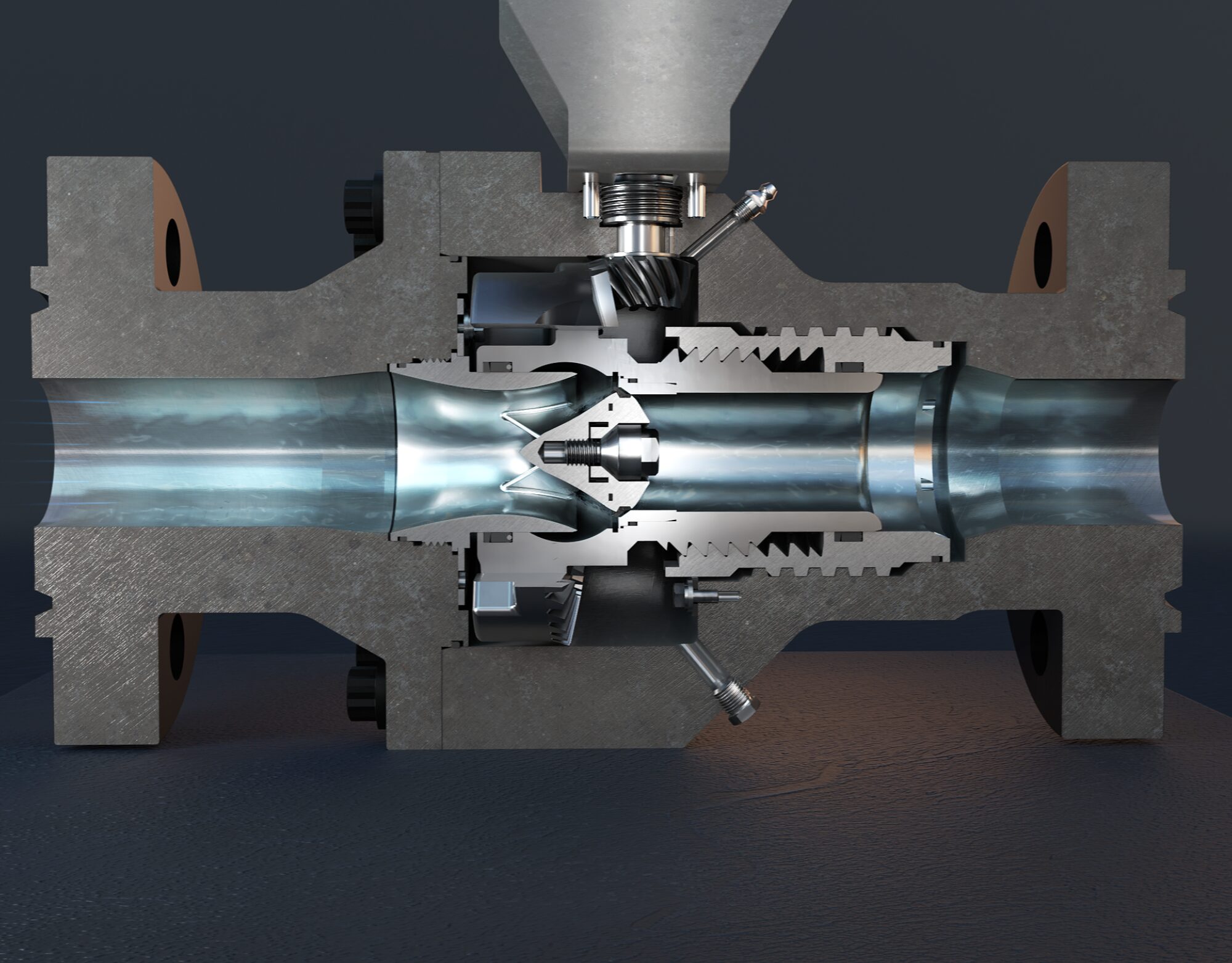
Built around a patented axisymmetric flow path, Atlas dissipates energy uniformly across 360° of the valve bore, eliminating the asymmetric turbulence and localized erosion that plague globe-style valves.
Protected by US Patents 9,103,421 and 9,404,561, Atlas has been proven in 10+ years of continuous field operation across oil & gas, petrochemical, and industrial applications worldwide.
Where Other Valves Fail, Atlas Survives
Standard control valves face critical failure modes in severe service. The Atlas was engineered to solve every one.
Erosion & Cavitation
Extreme pressure drops create vapor bubbles that implode against valve internals, destroying trim in 6–18 months.
Unpredictable Failures
Standard valves degrade without warning, causing unplanned shutdowns and costly emergency mobilizations.
Excessive Noise
Standard valves in choked-flow service generate 85–120 dB, creating safety hazards and regulatory violations.
Limited Rangeability
Do to limited range, standard control valves must be installed in parallel for applicaations with widely varying conditions.
The Atlas Solution: Axisymmetric Flow Technology
Unlike conventional globe valves that force fluid through tortuous, asymmetric passages, Severe Service Control Valves Atlas create a balanced, concentric flow pattern that dissipates energy uniformly.
- Pressure energy is dissipated gradually and uniformly
- Vapor bubble collapse is prevented at the molecular level
- Fluid exits the valve with minimal turbulence and noise
- Internal surfaces experience zero cavitation erosion
Engineering Features
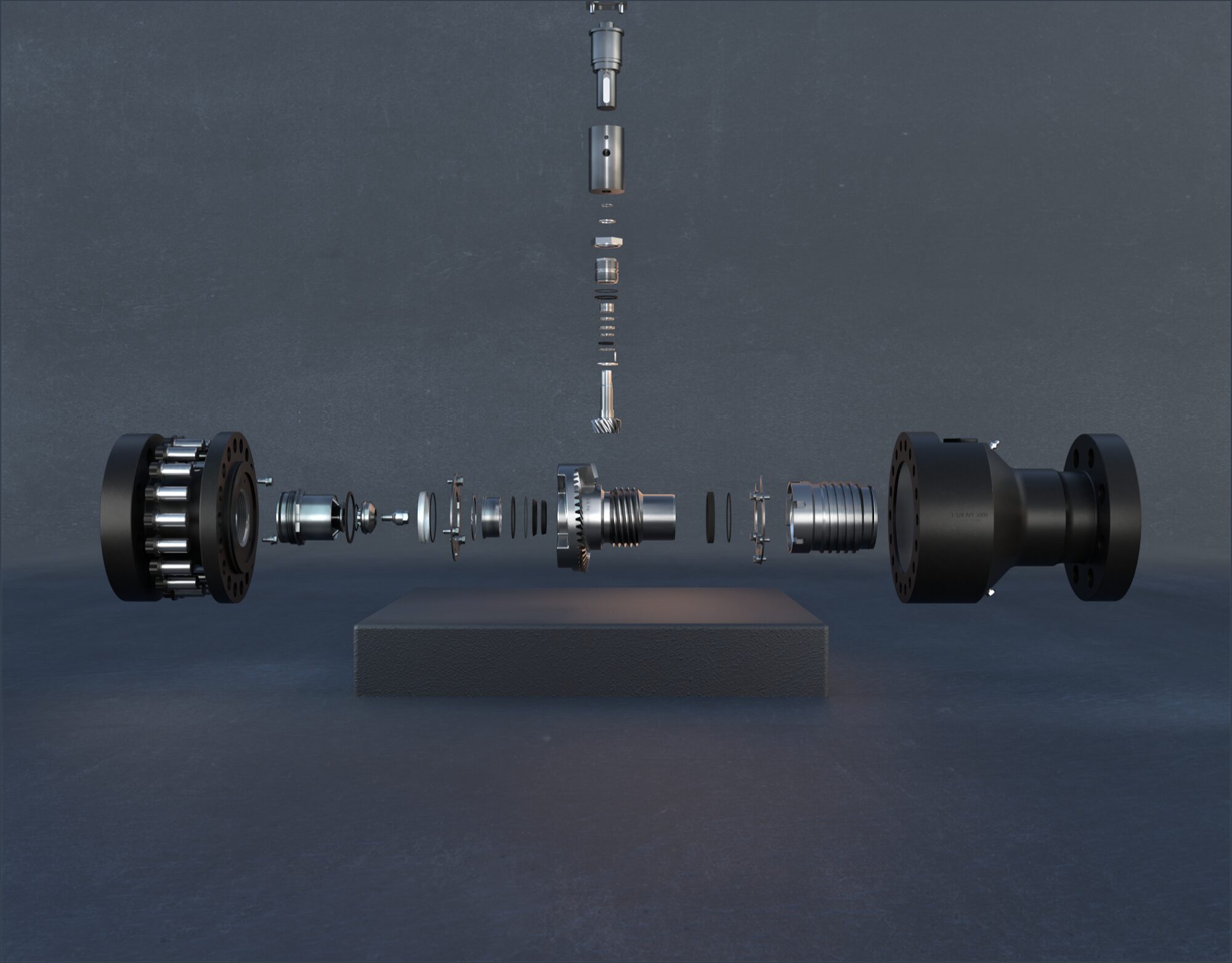
Every component of the Atlas SSCV is designed for extreme durability and precision control.
Multi-Turn Valve Stem
Precision multi-turn actuation provides fine throttling control across the full 700:1 rangeability range.
API 6A / ASME B16.34
Fully compliant with API 6A and ASME B16.34 standards for safety and pressure containment.
Triple-Sealed Design
Three independent sealing barriers provide redundant protection against fugitive emissions.
Isolated Flow Path
Process fluid is kept away from internal 17-4 PH actuation system components.
Stellited 316 or TC Trim
Standard Atlas material for flashing or abrasive particle erosion.
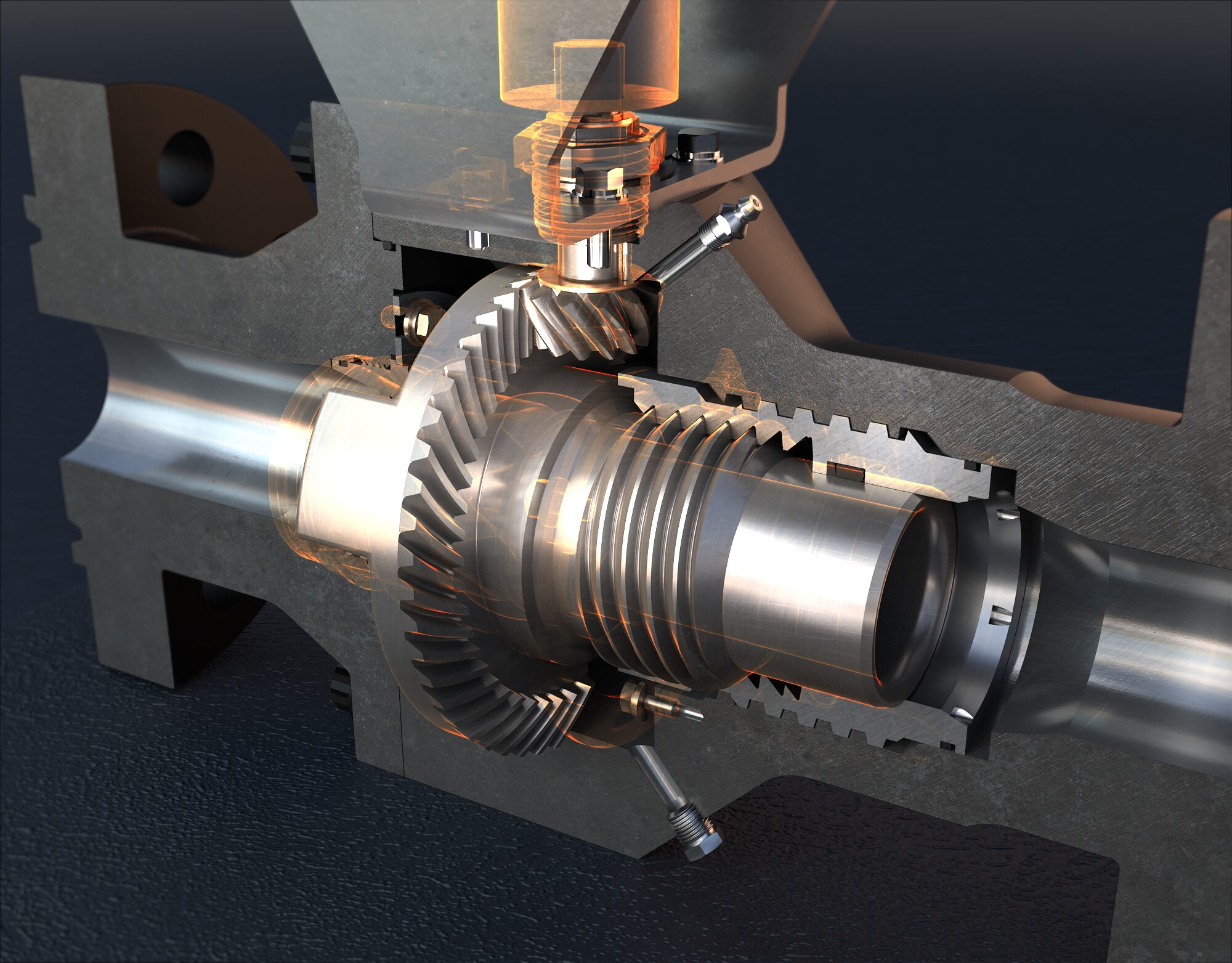
Helical Bevel Gear Drive
Internal helical gear translates rotary motion into precise linear positioning.
How It Works: Internal Actuation & Helical Gear
Atlas SSCV uses an internally actuated helical gear mechanism that translates rotary motion into precise linear trim positioning. This eliminates the external actuator common in globe valves, reducing the valve’s physical footprint and removing a major failure point.
The helical gear provides mechanical advantage that allows Atlas to operate at pressures up to 6,000 PSI with standard actuation force. The design is inherently self-locking, meaning the valve maintains its position even if actuation power is lost.
Proven Performance Specifications
Every number backed by 10+ years of field operation across oil & gas, petrochemical, and industrial applications.
| Maximum Pressure Rating | 6,000 PSI (ANSI Class 2500) |
|---|---|
| Control Range | up to 700:1 |
| Noise Level | <60 dB (under choked flow) |
| Cavitation Resistance | Zero damage after 10+ years of continuous operation |
| Available Sizes | Atlas 15 / Atlas 21 / Atlas 32 |
| Flow Capacity (Cv) | 70 – 300 |
| Temperature Range | 0°F to 450°F (-18°C to 232°C) |
| Body Materials | Carbon Steel, Stainless Steel, Duplex, Alloy 20, Hastelloy |
| Trim Materials | Stellite, Tungsten Carbide, Ceramic |
| End Connections | Flanged (RF, RTJ), Butt-Weld |
| Certifications | NACE MR0175, API 6D, ASME B16.34 |
| Patents | US 9,103,421 & US 9,404,561 |
Atlas SSCV vs. Standard Control Valves
| Parameter | Atlas SSCV | Globe Valve |
|---|---|---|
| Cavitation | Eliminated | Severe damage |
| Noise | <60 dB | 85–120 dB |
| Control Range | up to 700:1 | 50:1 |
| Max Pressure | 6,000 PSI | 2,500 PSI |
| Trim Life | 10+ years | 6–18 months |
| External Actuator | Not required | Required |
| Choked Flow | Native capability | Rapid failure |
ROI & Total Cost of Ownership
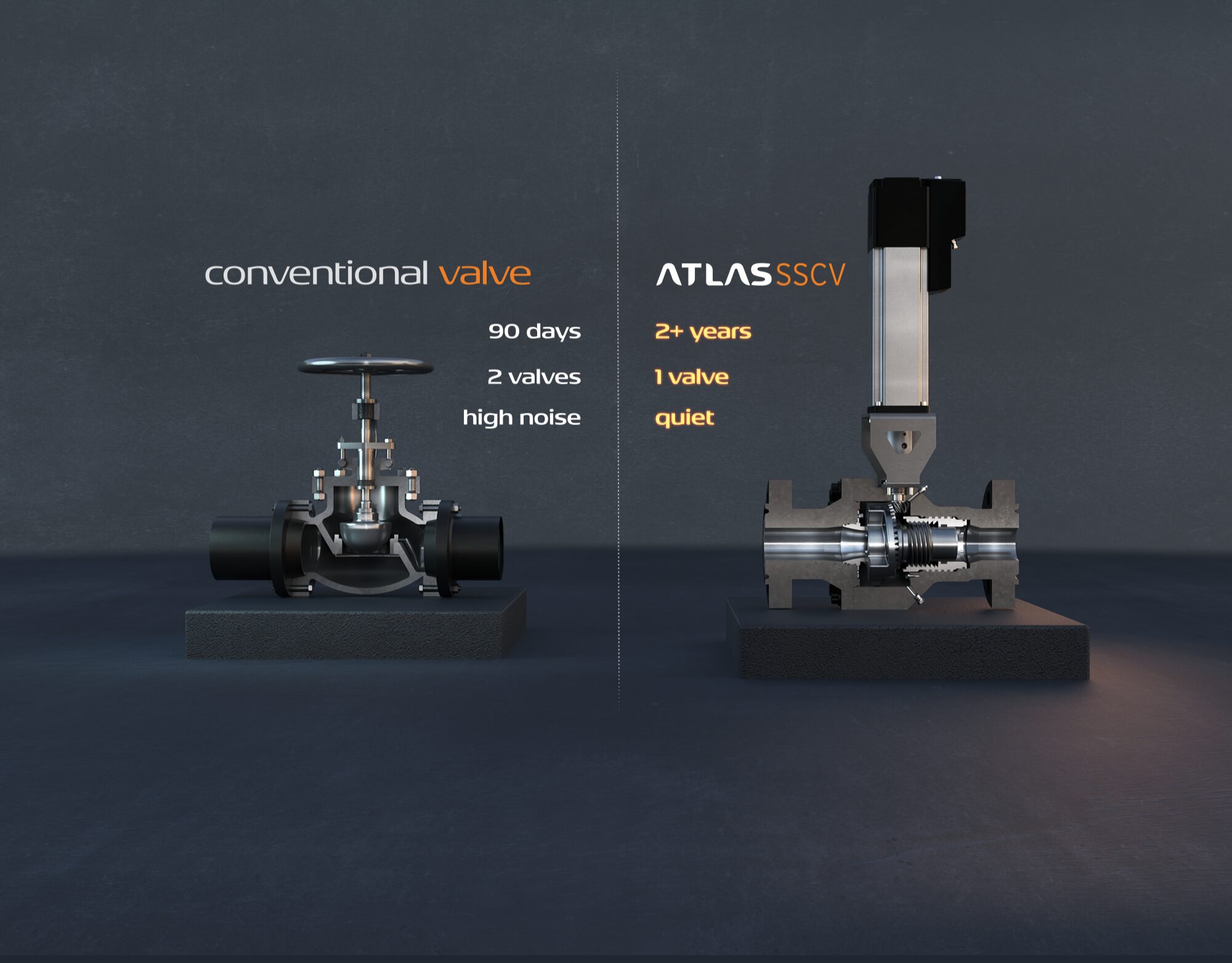
The Atlas SSCV dramatically reduces total cost of ownership by eliminating the recurring maintenance cycle that plagues conventional valves.
| Cost Factor | Conventional Globe Valve | Atlas SSCV |
|---|---|---|
| Refurbishment Frequency | Every 6 months | 2+ years between services |
| Rebuilds Required | 4 rebuilds in 2 years | Minor service only |
| Site Mobilization | 4+ site visits per year | Minimal mobilization |
| Downtime Risk | High — unplanned shutdowns | Low — predictable service |
| Total Cost of Ownership | Higher over valve lifetime | Significantly lower |
ATLAS replaced a ball valve equipped with an anti-cavitation baffle on our NGL line. Ha, we called it "the Screamer". After replacement with ATLAS the noise was gone and control improved.Operations ManagerMajor Oil & Gas Operator, Permian Basin
Applications
The Atlas SSCV is deployed across the most demanding industrial sectors.
High-pressure blowdown, wellhead choke, separator control, anti-surge protection.
View Application →Hydrocracker letdown, reactor feed control, fracking flow management.
View Application →Precision cooling loop control, chilled water balancing, noise-sensitive environments.
View Application →Power generation, mining, water treatment, desalination, and more.
View Application →Built for the Toughest Industries
From wellhead to refinery, Atlas handles conditions that destroy conventional valves.
Storage Well Blowdown
Managing high-pressure blowdown from gas storage wells where extreme pressure differentials create punishing conditions.
High-Pressure Injection & Pump Control
Controlling injection flow rates and pump discharge pressures in upstream operations.
Natural Gas Liquid Pressure Control
Regulating NGL streams where phase transitions and high pressure drops cause severe cavitation.
Hydrocarbon Refining
High-temperature, high-pressure applications in refining processes including hydrocracker letdown.
Case Studies
Learn more about the Atlas SSCV through our technical experience
Mark Lobo Talks Atlas SSCV
Watch our VP of Engineering explain the axisymmetric flow technology behind the Atlas.
Atlas SSCV Fact Sheet
Complete specifications, sizing data, and material options in a single-page PDF.
10-Year Field Performance Report
Detailed analysis of Atlas SSCV performance data from a decade of continuous operation.
Ready to See Atlas in Action?
Our Field Trial Program lets you prove performance in your own application — risk free.
Configure
Our engineers work with you to size and configure the Atlas for your specific application.
Compare
Install the Atlas alongside your existing valve and run side-by-side performance comparisons.
Prove ROI
Document the performance difference with hard data — noise reduction, zero cavitation, and savings.
Get a Custom Valve Recommendation
Tell us about your application. Our engineering team will provide a detailed recommendation including valve sizing, materials, and performance projections.
- Free engineering consultation
- Custom valve sizing and selection
- Performance comparison vs. your current valve
- ROI analysis based on your operating data